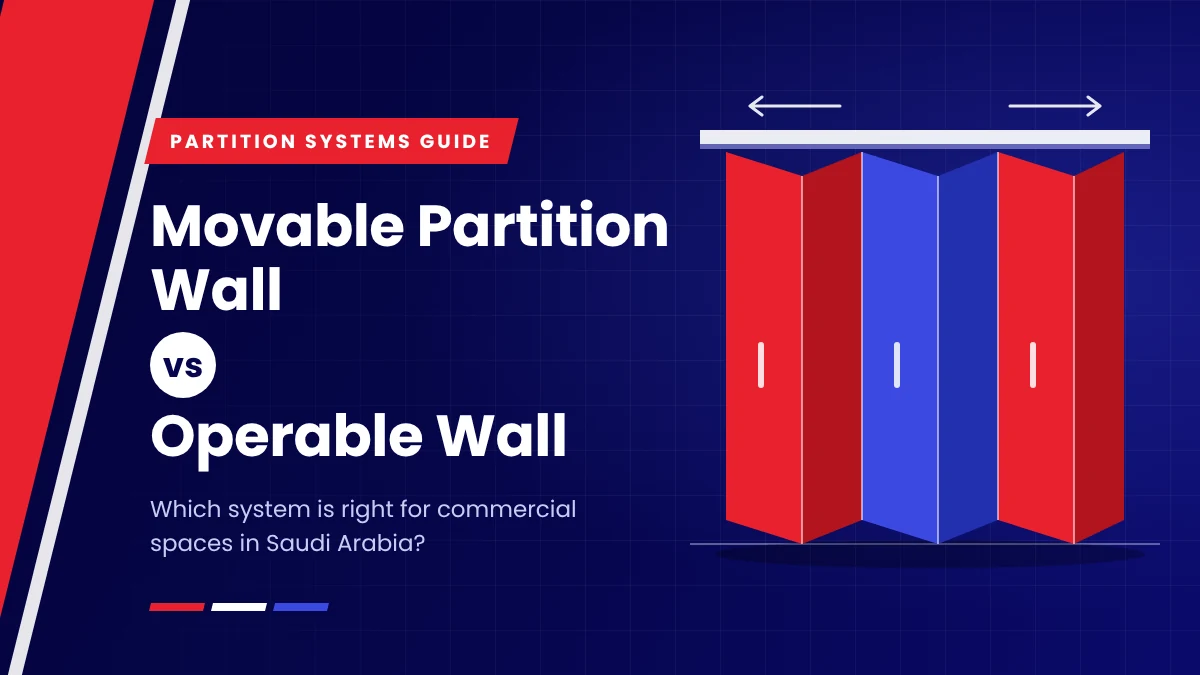
Commercial spaces in Saudi Arabia use movable partition walls and operable walls to create flexible layouts. Both systems support flexible layouts, but they operate differently. Choosing the wrong system can make future room reconfiguration more difficult.
What Is a Movable Partition Wall?
A movable partition wall is a demountable wall system built from individual panels that can be repositioned to divide a commercial space into smaller rooms or open it back into one larger space. Panels typically move along a track and lock into position, letting a facilities team change a layout without construction work. Offices, hotels, meeting rooms, and commercial buildings use these systems where spaces need different layouts over time.
What Is an Operable Wall?
An operable wall is a large-scale, floor-to-ceiling panel system designed to open, close, fold or stack, turning one large room into several smaller ones or combining them back into a single space. When closed, the panels seal against each other and the surrounding structure. When opened, they retract into a designated stacking bay. That mechanism lets operable walls handle wider spans than a typical partition system, central to how many commercial venues build flexible floor plans.
Movable Partition Wall vs Operable Wall: Key Differences
Movement and Operation
Movable partition systems are repositioned panel by panel, usually along a track, to build new room configurations. Operable walls instead open and close as a connected system, folding or stacking together in one continuous action rather than separate panel moves.
Space Flexibility
Both systems divide, combine, and reconfigure rooms, but suit different patterns of change. Movable partitions handle spaces needing several distinct layouts over time; operable walls suit spaces that mainly toggle between one large room and a fixed set of smaller ones.
Acoustic Performance
Sound insulation depends on panel construction and seal quality between sections in both systems. Where privacy and noise control matter, particularly between simultaneous meetings or events, the panel and seal system’s acoustic rating should guide selection, not the general system type.
Space-Saving Requirements
Panel storage and stacking needs differ between the two systems and directly affect usable floor space. Movable partitions generally need less dedicated storage, since panels reposition within the room itself; operable walls need a stacking bay sized to the full panel run.
Design and Finish Options
Both systems come in a range of surface finishes, from painted and laminate options to fabric-wrapped and glazed panels, letting either match a modern commercial interior.
Movable Partition Walls for Commercial Spaces in Saudi Arabia
Offices and corporate spaces use movable partitions to adjust workstation and meeting-room layouts as teams grow. Hotels and conference venues rely on them for function rooms serving different event sizes. Training and seminar rooms split or combine spaces between sessions, and educational buildings use the same flexibility for classrooms. Multipurpose commercial areas round out the applications.
Operable Walls for Commercial Spaces in Saudi Arabia
Conference and meeting rooms use operable walls to combine smaller rooms into one larger space for bigger gatherings. Banquet and event halls depend on them to scale a venue’s capacity to the event booked that day. Hotels and hospitality spaces use them across ballrooms and function areas, and large multipurpose rooms switch configurations quickly. Spaces needing frequent transformation, where layout changes more than once a day, are where operable walls do their most consistent work.
Movable Partition Wall vs Operable Wall: Quick Comparison
| Feature | Movable Partition Wall | Operable Wall |
|---|---|---|
| Main purpose | Flexible space division | Opening and closing large spaces |
| Space configuration | Multiple room layouts | Combine or separate larger spaces |
| Operation | Move or reposition panels | Open, close, fold, or stack panels |
| Acoustic privacy | Depends on system | Depends on panel and sealing system |
| Common applications | Offices, meeting rooms, commercial spaces | Conference halls, hotels, event spaces |
Which Partition System Should Commercial Spaces in Saudi Arabia Choose?
Start with the room configurations the space actually needs to support, since that often points toward one system. Acoustic and privacy requirements deserve a direct check against the panel and seal specification, not just the system category. Available storage and stacking space can rule a system out early, and how often the layout changes should weigh against the effort each system takes to operate. Matching the system to the building’s interior design and daily usage pulls these factors into a fitting specification.
Conclusion
Movable partition walls and operable walls both create adaptable commercial spaces, but they suit different patterns of use. Movable partitions suit spaces that need several layouts over time. Operable walls suit larger spaces that switch between one room and several smaller areas. The right choice depends on the required configuration, acoustic needs, available storage, and how the interior works day to day. At Azoz Operable Wall, we provide operable wall solutions for offices, hotels, meeting facilities, and event venues across Saudi Arabia.