A single hall can serve as a boardroom in the morning and a training suite in the afternoon, provided the wall between the two moves. This guide to movable partition wall systems covers how they work, their types, components, benefits, selection criteria, applications across Saudi Arabia, and installation and maintenance routines. Panel type, acoustic rating and operating mechanism determine which system is suitable for a particular space.
What Is a Movable Partition Wall?
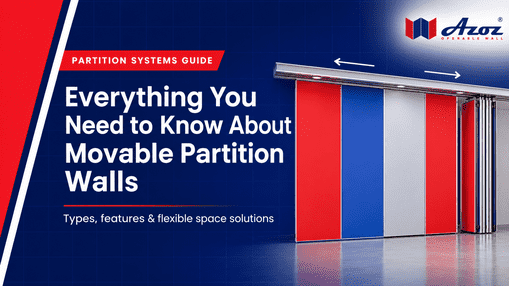
A movable partition wall is a panel system that slides or folds along an overhead track, dividing one large space into smaller rooms and clearing away on demand. What is movable partition terminology overlaps: operable wall and folding wall are related systems. Three features separate them from drywall:
- Repositionable panels that move without demolition.
- Overhead track support that keeps floors clear.
- Storage recesses that hold panels when open.
How Does a Movable Partition Wall Work?
A movable partition wall works by transferring panel weight to a ceiling-mounted track through rollers, so panels travel by hand or assisted drive.
- The operator draws each panel from storage.
- Panels align and lock at the joints.
- Head and base seals close remaining gaps.
- Reversing the sequence returns panels to storage.
What Are the Different Types of Movable Partition Walls?
Five types of movable partition walls dominate commercial projects: sliding, folding and sliding-folding, operable acoustic, glass, and solid panel systems.
Sliding Movable Partition Walls
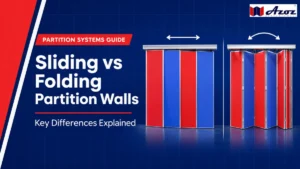
Sliding movable partition walls move individual panels along a single or paired track, one panel at a time. Each panel hangs independently, so the stack can sit at either end of the opening or inside a side pocket. Offices and meeting rooms suit them, since the wall works on a daily cycle.
Folding and Sliding-Folding Partition Walls
Hinged pairs define the folding system: two leaves meet at a vertical hinge and concertina together as the wall retracts. Sliding-folding versions add track travel to that folding action, which cuts the stack depth needed at the wall end. Multipurpose rooms gain the most because the stored wall claims little floor area.
Operable and Acoustic Partition Systems
Operable partition systems carry a rated acoustic core, built from mineral wool or a mass-loaded layer set between steel or timber skins. Retractable seals at the head, base and vertical joints close the air paths that carry sound. Conference rooms and hotel ballrooms specify these where two sessions run side by side.
Glass and Solid Panel Partition Walls
Glass panels hold daylight and sightlines across both rooms while still dividing them. Solid panels do the opposite: they block the view and take a wider choice of finishes, from laminate to veneer to fabric. Training rooms favour solid panels, while commercial interiors favour glass.
Table: Types of Movable Partition Walls
| Partition Type | Main Feature | Suitable Applications |
| Sliding | Panels move along tracks | Offices and meeting rooms |
| Folding | Panels fold for compact storage | Multipurpose rooms |
| Acoustic operable | Designed for improved sound separation | Conference rooms and hotels |
| Glass | Allows light and visibility | Offices and commercial interiors |
| Solid panel | Provides visual separation | Training rooms and private spaces |
What Are the Key Components of a Movable Partition System?
Five components make up a movable partition system: panels, tracks, rollers, retractable seals and the operating mechanism. Each one shapes how the wall moves and how well it closes.
Panels, Tracks, Seals, and Operating Mechanisms
- Panels: Create the physical division between spaces and carry the finish.
- Tracks: Guide the movement of panels and transfer their load to the structure.
- Rollers: Support panel movement along the track with minimal operating effort.
- Retractable seals: Help close gaps and improve acoustic performance where designed for that purpose.
- Operating mechanisms: Enable manual or assisted movement, depending on the system.
What Are the Benefits of Movable Partition Walls?
Movable partition walls deliver five practical benefits: layout flexibility, better floor utilisation, visual privacy, noise control in acoustic systems, and a choice of panel finishes.
Space Flexibility and Better Room Utilisation
One hall fitted with a movable partition wall can host a full conference in the morning and two breakout sessions after lunch. Venue operators gain extra rentable configurations without needing to build more rooms. Floor area that would sit idle behind a fixed wall stays in service.
Privacy, Acoustic Control, and Design Flexibility
- Flexible room configurations within a single floor plate
- Improved use of available floor space
- Visual privacy between adjacent areas
- Potential noise reduction with suitable acoustic systems
- Different panel finishes and design options
Where Are Movable Partition Walls Commonly Used?
Commercial buildings with changing room requirements are the primary users: corporate offices, hotels and banquet halls, conference venues, educational campuses, and multipurpose commercial spaces.
Offices and Corporate Meeting Rooms
Offices resize meeting rooms with movable walls as team sizes and project groups shift through the working week.
Hotels, Conference Venues, and Banquet Halls
Hotels split ballrooms into separate function rooms, then reopen the full span for larger events.
Educational Institutions and Commercial Buildings
Classroom walls in schools and training centres close for lessons, then open for assemblies and examinations.
Common Applications
- Corporate offices and meeting rooms
- Hotels and banquet halls
- Conference and exhibition venues
- Schools and training centres
- Multipurpose commercial spaces
What Is the Difference Between a Movable Partition Wall and a Permanent Wall?
| Comparison Factor | Movable Partition Wall | Permanent Wall |
| Purpose | Divides a space temporarily and reopens it on demand | Divides a space permanently as part of the building layout |
| Panel movement | Panels slide, fold or stack along a track | No movement; the wall stays fixed in position |
| Storage | Panels park in a pocket, recess or end bay | No storage; the wall holds its footprint at all times |
| Applications | Multipurpose halls, meeting rooms, banquet spaces | Structural partitions, service cores, fire compartments |
The core difference is movement: a movable partition wall opens and closes along a track, while a permanent wall stays fixed for the life of the building. A permanent wall forms part of the fixed layout and carries services in many cases, and removing it means demolition. A movable partition wall supports only its weight and the acoustic function built into the panel, so the room plan changes within minutes instead of weeks. Cost behaviour also differs. The fixed wall is cheaper to build once, while the movable system returns its value through repeated reconfiguration, which is why buildings that rarely change layout don’t recover the outlay.
How Do You Choose the Right Movable Partition Wall?
Choosing a movable partition wall rests on five checks: space dimensions, track support, acoustic requirement, panel material, and operating frequency.
Evaluate Space Dimensions and Layout
Measure clear opening width, ceiling height and storage depth before shortlisting a system. A 12 m opening without a side pocket requires a different stacking arrangement than one with an end recess.
Consider Acoustic Performance and Privacy
Acoustic requirements drive panel thickness and seal design. A boardroom beside a cafeteria needs a higher rating than two adjoining training rooms. State the target in Rw or STC terms when requesting quotations.
Check Materials, Finish, and Ease of Operation
Panel finish and operating effort govern how the wall holds up in service. Fabric, laminate, veneer and glass respond differently to scuffing. Frequent use justifies an assisted mechanism.
Key Selection Factors
- Available floor space and ceiling height
- Track support and panel storage requirements
- Required acoustic performance and privacy
- Panel material, finish, and durability
- Operating frequency and maintenance requirements
What Should You Know About Movable Wall Partitions in Saudi Arabia?
Hotels, corporate offices, conference facilities and commercial developments across the Kingdom account for most Movable Wall Partition demand in Saudi Arabia, where a single hall has to serve several booking patterns. Specifying a movable wall partition in Saudi Arabia usually means designing around the wide clear spans and tall ceilings of new-build projects, which pushes track support to the top of the checklist. Banquet and exhibition halls carry the heaviest operating cycles.
Key Considerations
- Building layout and available installation space
- Acoustic requirements and room usage
- Panel configuration and operating mechanism
- Installation conditions and maintenance needs
How Are Movable Partition Walls Installed and Maintained?
Installation runs through four sequenced steps, and maintenance follows a short inspection cycle repeated throughout the year.
Installation Considerations
Site conditions govern the installation sequence, so each step confirms the one before it.
- Measure the site and confirm the layout.
- Check ceiling support and track requirements.
- Install and align the track system.
- Position the panels and test their movement.
Routine Maintenance
A movable partition wall needs three recurring checks to keep it operating smoothly.
- Inspect tracks and rollers.
- Check seals and panel alignment.
- Follow the manufacturer’s maintenance instructions.
Conclusion
Movable partition walls turn single large rooms into bookable, revenue-earning spaces across offices, hotels, schools and conference venues. Knowing all about movable partition systems matters less than matching one to the building layout, acoustic needs, operating requirements and intended use.
Frequently Asked Questions
What Is a Movable Partition Wall Used For?
Movable partition walls divide one large room into smaller usable spaces and reopen it when the full span is needed. Conference halls, hotel ballrooms, offices and classrooms rely on them most.
Do Movable Partition Walls Reduce Noise?
Acoustic operable systems reduce noise; standard sliding and glass panels don’t give the same separation. Seal design at the head, base and vertical joints determines how much sound crosses between rooms.
Can Movable Partition Walls Be Customized?
Panel finish, height, thickness, glazing and operating mechanism can all be specified to the project. Fabric, laminate, veneer and glass are the usual finish choices.
Are Movable Partition Walls Suitable for Commercial Buildings?
Yes. Offices, hotels, exhibition centres and training facilities install them wherever room requirements change throughout the week. A movable wall partition in Saudi Arabia commonly serves hotel and conference projects of this type.
What Should Be Considered Before Installing a Movable Partition Wall?
Check ceiling support, clear opening width, panel storage depth and the required acoustic rating before ordering. Operating frequency and maintenance access matter most for walls used every day.